
Volatility Forecasting
Across Assets

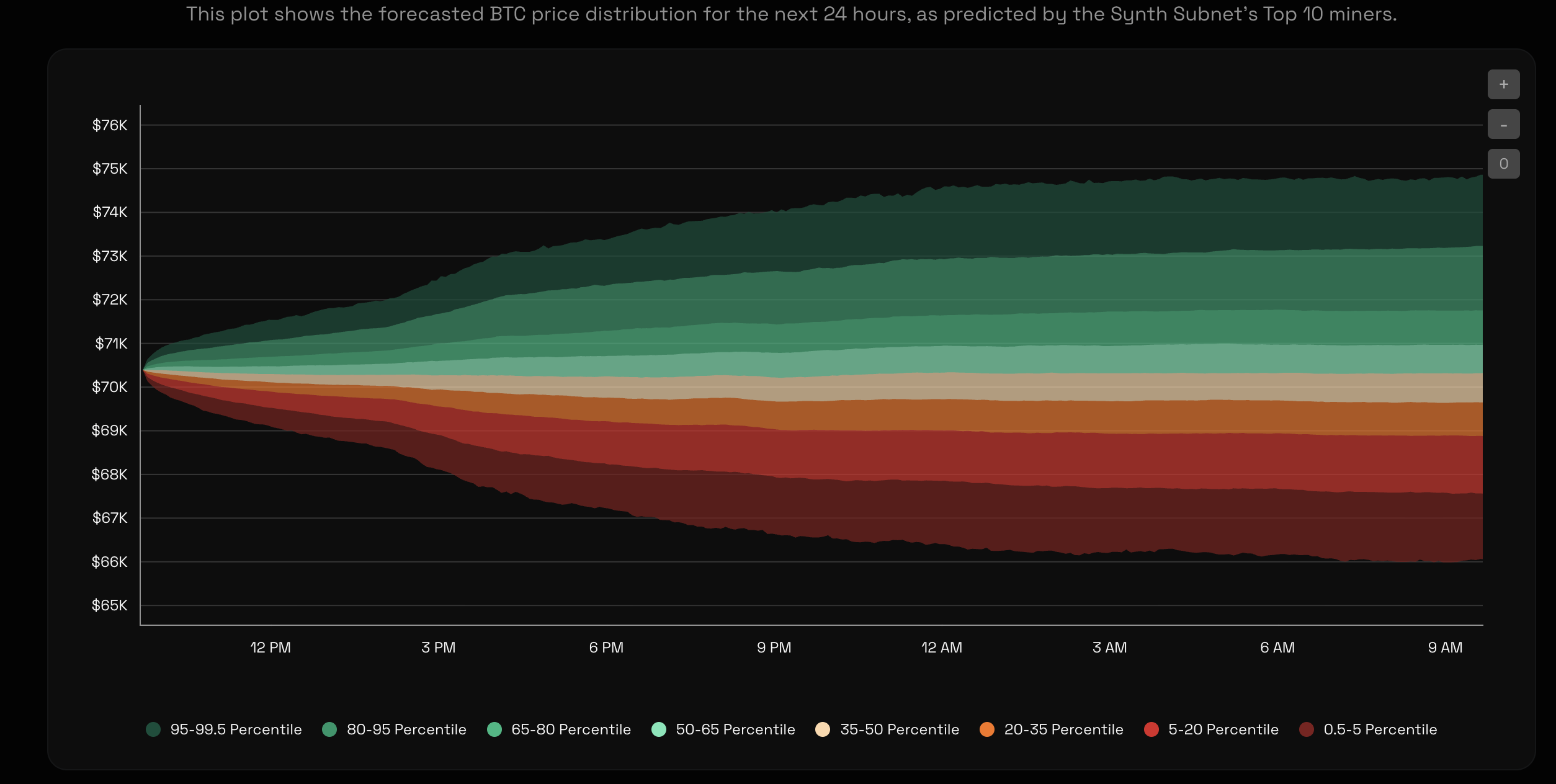
Synth generates forward volatility forecasts for crypto, equities, and commodities - a foundational data layer powering risk models, pricing engines, and automated trading systems

Moving beyond realised vol to probabilistic volatility forecasts

Risk managers and quantitative systems across asset classes rely on realised volatility, historical distributions, and lagging indicators. Very few have access to a continuously updated forward volatility forecast that reflects how price is likely to behave, not just how it has behaved. Most risk models are built on backward-looking inputs rather than a live probabilistic view of future price dispersion
A Volatility Data Layer Built for Multiple Use Cases

Risk managers and quantitative systems across asset classes rely on realised volatility, historical distributions, and lagging indicators. Very few have access to a continuously updated forward volatility forecast that reflects how price is likely to behave, not just how it has behaved. Most risk models are built on backward-looking inputs rather than a live probabilistic view of future price dispersion

Smart Treasury

Forward Volatility Forecasts

Model-generated estimates of future price dispersion over 1h and 24h horizons - not lagging realised vol

Onchain Referals

Multi-Asset Coverage

Crypto, equities, and commodities including gold - a single API for volatility intelligence across markets

Developer Incentive

Plug Into Any System

Feed Synth's output directly into options pricers, risk engines, liquidation monitors, or LP tools via API or MCP

Synth API Supported Assets

BTC
ETH
SOL
XAU
SPY
NVDA
TSLA
APPL
GOOGL

Core metrics

$2.9m paid to data scientists
20-30% Improvement on GBM benchmark
Hundreds of AI models competing in real-time
FAQ

What is forward volatility forecasting and why does it matter?

Forward volatility forecasting estimates how much an asset's price is likely to move over a future time period — as opposed to realised volatility, which measures historical movement. For risk managers and pricing models, forward vol is a more actionable input because it reflects expected future conditions rather than past behaviour.

How is volatility forecasting different from implied volatility?

Implied volatility is derived from options market pricing and reflects collective market sentiment. Forward volatility forecasts like Synth's are derived from price path models trained on historical and real-time data - providing an independent estimate that can be compared against implied vol to identify potential mispricings.

Which assets does Synth provide volatility forecasts for?

Synth provides forward volatility forecasts for crypto assets, equities, and commodities, including gold - accessible via a single API. This makes it a consistent volatility data layer across multiple asset classes and use cases.

How can volatility forecasts be used in automated trading systems?

Synth's volatility output is designed to be consumed programmatically via API or MCP. It can feed directly into options pricing engines, liquidation risk monitors, LP range optimisation tools, or portfolio-level risk models - anywhere a forward-looking vol estimate improves decision quality.